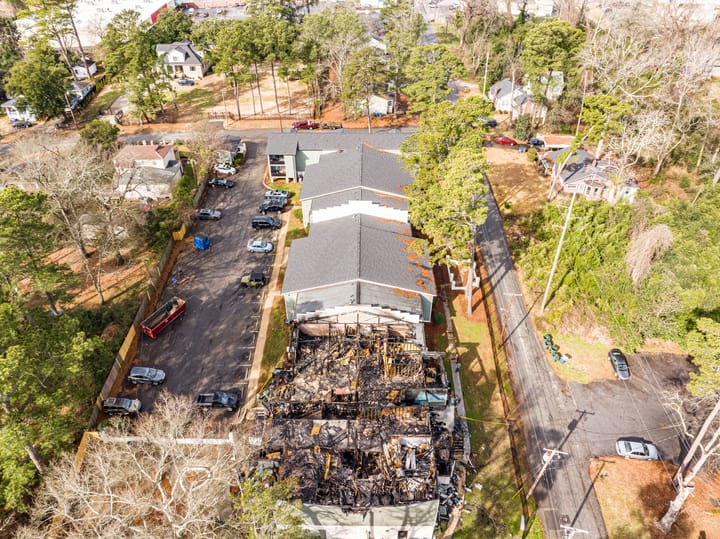
“Your building is on fire.”
That’s how a phone call started for Rachael Jones two years ago on a Tuesday afternoon. Pulling up her property cameras, she verified that, yes, her building was indeed on fire.
She jumped in her car and drove down the highway to the apartment complex she owned in Columbia, North Carolina. Her car was moving fast, her brain was moving faster, and she asked herself a million questions: What should I do? Who should I call? Who should I NOT call? Who do I know that’s been through this? Oh, no, the kids get out of school in 20 minutes and my husband’s out of town, who can pick them up? What do I tell my tenants?
Thanks to the communities she’d built and the connections she’d made, Rachael Jones’ real estate career became more successful than ever.
It wasn’t always real estate for Rachel. She and her husband both began their careers as mechanical engineers in the energy industry, but a round of layoffs in 2016 had the couple contemplating their financial future.
“We saw a number of people around us get fired. We were not part of that, but it kind of scared us straight a little bit so we said, ‘Hey, this could happen to us at some point, so we want to find a way to have a side gig, right?’ And my father-in-law had been pushing us for years to look into real estate,” she said.
Eventually, the two settled on buying a pair of single-family homes next to each other in South Gastonia, NC at a bargain price of $40,000 for both. The homes were built in 1910 and in horrible shape, with one completely missing a kitchen floor; one home was inhabited by a person suffering from heroin addiction and the other was inhabited by a known drug dealer.
The couple booted both tenants, who hadn’t paid rent in some time. Especially difficult was getting rid of the drug dealer, who got into a “shouting match” with Jones in the backyard as she “pretended that I was totally confident in my head while hoping I wasn’t going to get shot.” With the units empty, Rachel and David got to work.
“We fixed them up ourselves, top to bottom. I wore all the different hats as I gave birth to a newborn at the same time. My father-in-law gave us a bit of advice… and YouTube was fantastic… but we had to do everything from installing floor joists to electrical to plumbing because it was so old,” she said.
Even the doors were a pain point, as they all had to be custom cut to fit the misaligned studs, “or else you just rebuild the entire house, which we didn’t have the budget for.”
After six months of working evenings and weekends on renovations, in addition to working their full-time jobs and raising a newborn, the couple finally finished the first house. The couple put six or seven thousand into the house, and began renting it for $650 a month. Eventually, they finished the second home, and later sold both for $160,000 total a few years later—a profit of over $50k on just the first home alone, without even including the rent they’d been charging for years.
Over time, Rachel continued purchasing one-off properties: another single-family home here, a triplex there. She’d take six months to “breathe” and then say “Ok, now I’m bored, I want another project.” As she was working her way into real estate syndication (raising money from other people to buy properties), the COVID-19 pandemic hit, and new opportunities opened up in unexpected ways.
During the pandemic, real estate networking moved from in-person to Zoom calls. Several communities and influential figures that Jones would never have had access to were now in front of her on her phone as “everyone had to advertise themselves all of a sudden.”
“They’d go ‘Hey, we have our zoom meeting here!’ and give out their link to everybody for free just to get people to call in,” she said.
One of the most impactful meetups she found was an investment group solely made up of women who all had very different backgrounds. Whether they were podcast hosts in the U.S. or professional dancers in Europe, each member had one thing uniting them: their interest in pursuing real estate as a source of income.
“Pretty much everybody comes from a different place and a different reason for wanting to do real estate… That perspective [is] something that you miss working a full time job,” she said. “Everybody seems to be pretty much in lockstep that we're all working until retirement... You're in the office from eight to five and trying to climb the ladder to be normal. And being exposed to these other communities makes you realize [working at a desk forever] does not have to be normal, and that changes your perspective of how you want your life to look.”
From there, her real estate education went into overdrive. Part of that is thanks to Brian Brisco and his Tribe of Titans class, which Jones was one of the first graduates of.
“Brian is a great resource for me. He was actually a partner on some of my deals, and I’ve met many other really great people through him, but Tribe of Titans was really important,” she said. “If you’re new to real estate investing, you can come in and learn ‘what is an LOI,’ ‘what is a PSA,’ …then learn about underwriting, and learn what to do next.”
After that course, she focused on talking to as many people as humanly possible, with a particular focus on the real estate community on Twitter/X. There are a bunch of “really, really smart” investors on the social media platform who are constantly sharing tips and tricks that she learns from. One of her closest connections from the site is Moses Kagan, the host of the networking conference ReConvene in Los Angeles—”the one conference I always try to go to now.”
During her time at that conference, her and Kagan built a connection that later paid off in a huge way. Kagan eventually founded an investment fund called ReSeed that provided young real estate investors with funding and mentorship, and of the nearly 700 applicants for the first few slots, Jones was one of the people selected. The funding from ReSeed was the catalyst for her to finally jump into real estate full-time in October 2023.
As she was getting into real estate full-time, Jones purchased a 29 unit complex in Columbia, SC that was in disarray.
The owner, who lived in Korea, had been losing money on the property for years. Deep in tax debt and with several units not up to code, the owner was desperate to sell, and he “didn't care at what price, he just wanted out.” Jones purchased the property at a significant discount with the intent to see a “transformation” in the area and to “make an impact in the local community,” and promptly got to work on the renovation.
Then came the fire. In January 2024, just a few months after Jones made real estate her full-time job, a freak electrical accident started a fire and decimated eight of the 29 units. Four additional units were damaged by firefighters busting through the walls. The 17 remaining units, however, were still livable. Some tenants returned to their homes that night despite not having water or power.
“We’re not just dealing with a disaster. We’re dealing with people trying to live normal lives in one half of the building, and in the other half of the building we’ve got people who lost everything,” she said. “We couldn’t just kick everybody out, and we didn’t want to.”
Rachel slept on the floor of the building’s office for three days while she managed the damage, but she refused to be the main point of contact for anyone other than her tenants, a tip given to her by one of her real estate connections. Instead, she directed calls from the media, insurance adjusters, contractors and others to her assistant—a move she says was the smartest decision she made during the crisis.
“That was a huge help, because then I could focus on boots-on-the-ground stuff and not have those long conversations where somebody's trying to hard sell me on using their services when I'm trying to focus on other stuff,” she said. “There were a lot of people trying to get money out of us. There's restoration companies that chase police and fire department scanners… if they can get you while you're just in the middle of it and going crazy from the chaos, then they know that they're going to make more off of it.”
She focused on what was important: the people. Jones provided her tenants with plenty of food and water, and made sure to call the Red Cross as part of her earlier flurry of phone calls, thanks to another tip given to her by a real estate colleague. The organization provided immediate care and hotel vouchers for those affected.
“It’s the little things, right? If you’re just focused on, ‘Oh my god, the fire, the property burned down,’ you forget people are still trying to live here,” she said. “Treat them like people and communicate. You don’t need to tell them every single thing, just enough so they feel like somebody’s paying attention, taking care of it, and that we’ll all be fine at the end.”
Most of the tenants from damaged units broke their lease; Rachel let them without penalty, and gave their full deposit back.
One of Jones’ other properties was in Mount Holly, a small town just outside of Charlotte. The 28-unit building was a 1970s-townhome style complex, but the owner had let it fall into disrepair. Rachel got through fixing 25 of the units, found tenants to fill them, and was preparing to sell the property.
Then Hurricane Helene hit in September 2024 and caused major flooding all over North Carolina—including in all the units Jones had just spent over a year fixing up. (Once again, Rachel again found out from a contractor call and local security footage.)
While the property did have a third-party property manager, she was still involved in contacting tenants to let them know that they needed to evacuate for their safety.
“The way we treated it was, ‘Look, we have to get you out,’” she said. “We know it’s your home. Nobody expected any of this, but it’s unsafe for you to be here, and our concern right now is making sure that you are safe and then that we stop the damage that's already starting to happen.”
Once again, the Red Cross showed up—as well as FEMA—to provide immediate care and to provide hotel vouchers for the tenants affected.
Since every unit was ruined, Jones and her group of handymen needed to move quickly to prevent further damage. One major problem, though, was that Jones couldn’t remove or throw out anything from the apartments without express written consent from the tenants. While most tenants were happy to agree, given that all of their belongings had been soaked in river water, there was one tenant that refused to vacate and actively put themselves in danger.
“Duke [Energy] shut off the power to all of the buildings but the front ones. And so this one tenant would keep turning the power back on. Which is a huge fire hazard because the building has just flooded,” she said. “We would go back, lock it, they’d cut the lock off and turn the power back on. It was probably like this for a week and a half to two weeks.”
Eventually, after having a sit-down with Jones, the tenants were finally convinced that it probably wasn’t the best idea to keep risking their lives for a flooded apartment.
Despite the building’s tenants evacuating the building and finding a new place to live, several came by during the rebuilding process to check their mail and ask when they could move back.
“They would look around and ask, ‘Hey, when are the units gonna be ready so we can move back in?’ And I loved that, because it showed that the community was definitely worth saving.”
With two major crises under her belt, Jones was well-prepared for the next property of hers to need major renovations. In June 2025, she returned to Gastonia, NC—the place where she bought her first ever property—to purchase an apartment complex with a joint venture partner. The property would need new water lines, new windows, and more. To do so, Rachel planned to vacate the building, renovate each unit, and then lease it all back up. This meant zero rent for months and a big investment, a “risky move,” she said, but a worthwhile one to improve her local community.
“[This property] is in a neighborhood where this could really be a catalyst… to help pull the entire neighborhood up,” she said. “Nobody has really put in the time and effort into building this [area] another way, and it’s in a location that could really benefit from it.”
Thanks to the previous fire and flooding incidents, she was already acquainted with how to let tenants know that they’re living in an unsafe building, and how to “get people out of the apartments in as kind of a way as possible.”
“I'm a very firm believer that you don't need to use a stick to get people to do what you want. You just need to apply the right incentives and have a human conversation with them,” she said.
Her goal in getting out the tenants was “speed” so renovations could begin immediately, which required a multi-phase plan.
First, any tenant with a balance of overdue and unpaid rent would be forgiven as long as they were out by the Monday after the deal on the property closed. They’d even get their security deposit back. Every tenant, including one that owed $6,000 in back rent, took Jones up on the deal. She said it “wasn’t our money that we lost,” and while she could’ve spent months of valuable time fighting in eviction court if she really wanted to, she opted to help those people “move on” and find somewhere else to go.
Next, she gave the remaining tenants 30 days notice to vacate, but gave them all lists of similarly-sized, similarly-priced units in the area and connected them with local property managers. All the tenants who took this deal also got their deposit back, as “we’re going to demo it anyway.”
That left just two tenants who held out. The final holdout didn’t want to go through the hassle of moving, so Jones paid professional movers to move her things into her son’s three-bedroom home just down the road, where she is “much happier now.”
“We were able to get every one of those units vacated in two months with zero evictions,” Jones said. “And that made me feel really, really good.”
A fire, a flood, and a mass exodus in a year and a half (in addition to managing several other properties) right after going into real estate full-time—how does Jones stay positive?
“I’m a glutton for punishment,” she says, laughing. “I don’t know. I’ve always run towards the fire instead of away from it, even back when I was an engineer… I don’t want these things to happen, but I’m always like, ‘Oh, that’s a fun problem.’ You have to ask yourself, where’s the silver lining? How do I turn this into a positive? That’s what I get into in the middle of a crisis.”
For example, she pointed out how the fire allowed her to expand the size of each unit that was burned down. Now, instead of eight two-bedroom units, she’s got eight three-bedroom units. Everything’s brand new in the building, too, with new laundry facilities, an added workshop, and extra basement storage available to all tenants.
Talk to Jones for five minutes, and she’ll bring up this idea of “community”—finding a community, improving your community, doing good unto others, leaving a neighborhood better than you found it. Her desire to make sure others have their own community comes from her initial lack of one.
“I didn’t really have a big community when I was a kid, and I always wanted to. Don’t get me wrong, I had a great childhood, but we grew up in a neighborhood where I had two other kids not in our grade,” she said. “That’s driven me to realize how important community is and how much of an impact it can have, and that’s what I look for in every project. I want to build up a community and make sure everyone’s connected in a real way.”
Part of building a community in the real estate world, however, requires being as authentic as possible—especially when it comes to investors.
“There are many, many people on this earth that can put a hundred thousand dollars or 500,000 into someone else's thing. And you don't know until you start asking the questions,” she said. “The farmer down the street might have 500k. They're willing to invest with you versus the person across the street with the fancy Audi and house and everything. The trick is just to tap into it, right? You gotta get a group of people… that trust you."
For her, building trust comes down to an “old-fashioned” principle: keeping your word.
“You gotta do what you say you’re gonna do. If you say you’re going to email them, do it. If you say you’re going to call them, call them. All these little interactions add up to say, ‘Okay, this person’s reliable,’” she said. “That’s really all it comes down to is ‘Can somebody trust this operator.’”
Jones says people in the real estate realm “can hide so much in Excel spreadsheets or documentation or pretty marketing.”
“But the reason that you're an operator or GP is because you are the expert on that investment, on that property, on that business plan. Everybody else is playing catch-up to what you know. And so it’s really… can they trust that what you're telling them is true?,” she said. “Even if it’s just sending a regular newsletter every month. If you promise to send it every month, and you do, and it’s actually interesting, that builds people’s confidence in you, even if you’re never going to make a deal together.”
Rachael Jones is the founder of Initech Management and Clover Capital Group. You can follow her on Twitter/X at @clover_cap.
